the quirinal hill
the quirinal hill rises slowly eastward from the campo marzio. in earliest roman history, when rome was only a small settlement on the palatine hill, it was a settlement belonging to the sabines. it was never heavily settled in the roman or medieval eras, so was first built up during the baroque era. it is now filled with mansions and palaces dating from the 17th and 18th centuries, and is also known as a district of luxury boutiques.
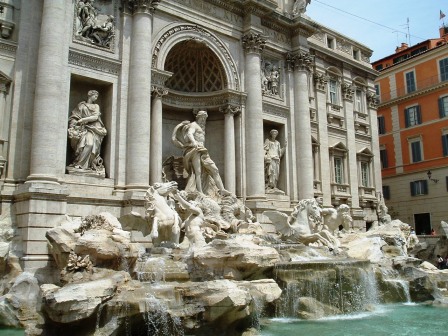
the most famous sight on the quirinal is the trevi fountain, designed by Nicola
salvi, and intended to "finish off" the end of a canal that brought
water from a spring 13 miles away to the city of rome.
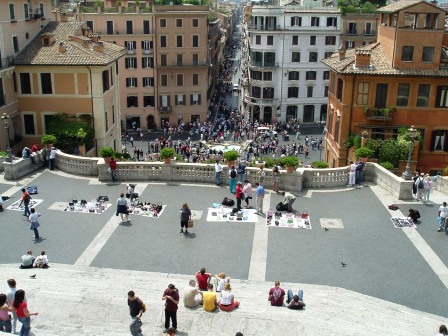
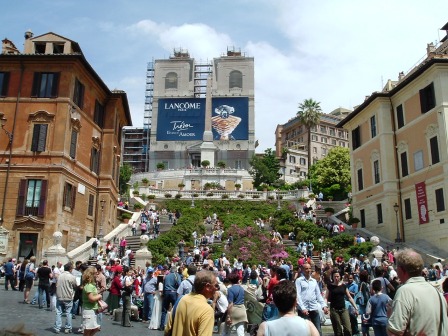
not far away are the equally famous spanish steps, so called because the spanish
ambassador to the pope had his residence nearby. the first photo is taken from
the top looking down and the second from the bottom looking up (unfortunately,
the church at the top of the steps was undergoing renovations, so was covered
with scaffolding and advertizing.) Note another egyptian obelisk near the top.
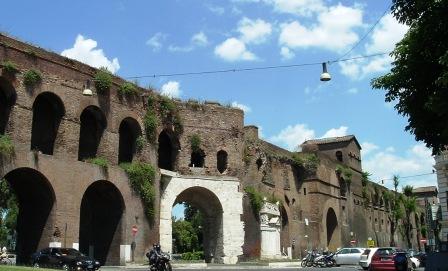
the edge of ancient rome is marked by walls that still survive in many locations.
the walls were built by the emperor aurelian in the 3rd century, when germanic
invaders first began to threaten the roman empire (it was germans who were responsible
for the fall of the roman empire in the 5th century). here is the porta pinciana,
refortified in the 6th century by the byzantine emperor justinian, who reconquered
rome and most of italy (but whose victories were undone by the arrival of the
lombards, a new germanic people, into the region).
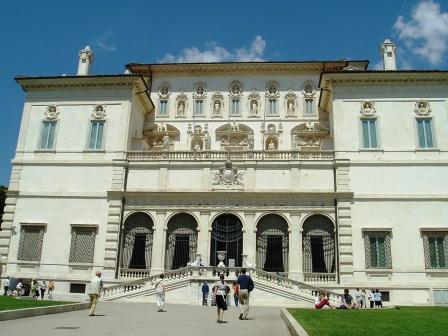
outside of the walls is the villa borghese. it is now a public park but in the
17th century it was the residence and private gardens of cardinal scipione borghese,
nephew to pope paul V. inside the palace is a small museum.
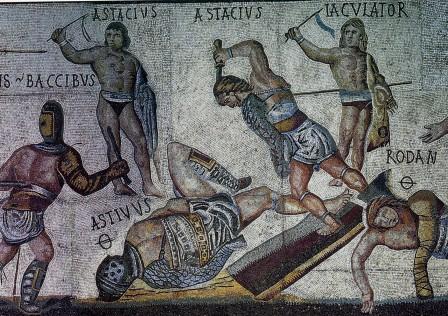
the museum includes this roman-era fresco of gladiators, each named so perhaps
representing actual well known individuals.
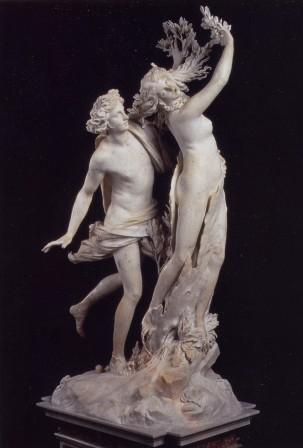
the museum also includes this baroque sculpture by bernini, showing the god
apollo's unsuccessful attempt to rape the nymph daphne, who prayed to her father,
a local river god, who transformed her into a laurel tree.
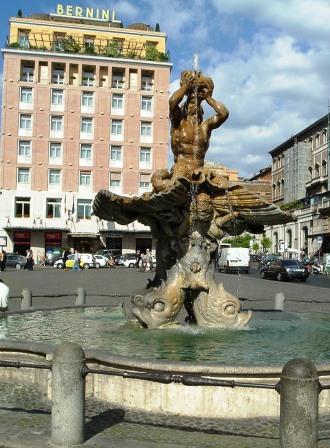
on the classy via veneto, filled with luxury hotels and shops, is another bernini
fountain, called the fountain of the titan.
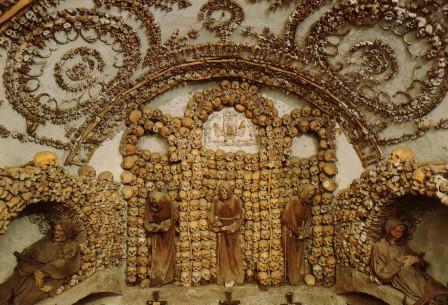
also on the via veneto was the weirdest sight in rome, the crypt of the church
of santa maria della concezione. the decorations of the crypt are provided by
the bones of hundreds of capuchin monks. note the arches against the wall, comprised
solely of skulls. why some monks were preserved whole--even tied standing up
here, as well as lying down--and others disassembled we could not determine.